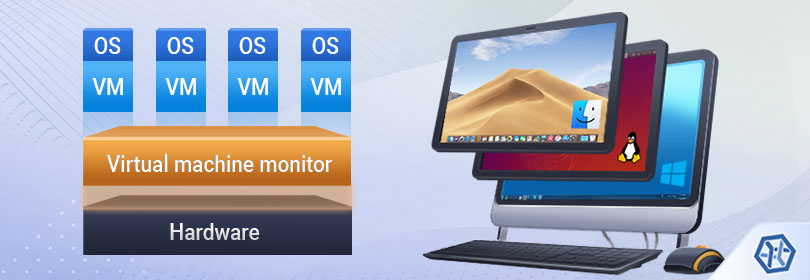
A Virtual Machine is a type of server that uses software to run programs and run apps on a physical server. It can run on any type of server, such as a physical PC.
Virtual machines are becoming more prevalent in cloud computing. They are typically used for various use cases such as multi-tenant cloud computing, batch processing, and remote desktop.
Virtual machines are desktop software that behaves like a full-fledged computer in an app window. They can run different operating systems and test applications in a secure, sandboxed environment.
Roles and Applications of VMs:
- The multiplicity of Operating Systems.
- Reduced Overhead.
- Rapid Disaster Recovery and Auto Backups.
- Scalability.
- Centralization.
Functionality of Microsoft azure:
- Microsoft Azure supports all 3 types of deployments, public, private and hybrid.
- Application development: you’ll create any web application in Azure.
- Testing: After developing an application successfully on the platform, you’ll test it.
- Application hosting: Once the testing is completed , Azure can assist you host the appliance .
- Create virtual machines: you’ll create virtual machines in any configuration you would like with the assistance of Azure.
- Integrate and sync features: Azure allows you to integrate and sync virtual devices and directories.
- Collect and store metrics: Azure allows you to collect and store metrics, which may assist you find what works.
- Virtual hard drives: These are extensions of the virtual machines; they supply an enormous amount of knowledge storage.
Services of Microsoft Azure:

Azure virtual machine:
Azure Virtual machine will let us create and use virtual machines in the cloud as Infrastructure as a Service. We can use an image provided by Azure, or partner, or we will use our own to make the virtual machine. Compute, Networking, and Storage elements are going to be created during the provisioning of the virtual machine.
Load Balancing:
An Azure load balancer is employed to distribute traffic loads to backend virtual machines.
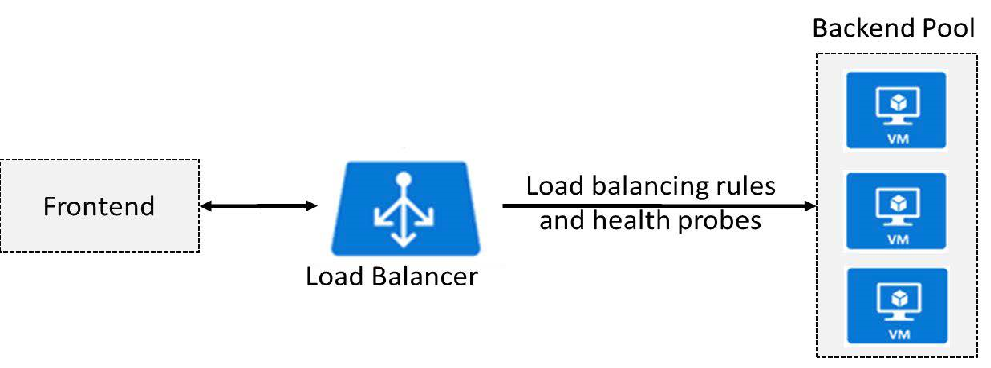
Features of Azure load balancer:
- Port forwarding: Load balancer also has port forwarding capability if we’ve a pool of web servers, and that we don’t need to associate public IP address for every web server in that pool.
- Automatic reconfiguration: Load balancer can reconfigure itself once we proportion or down instances.
- Health probes: The load balancer can recognize any failed virtual machines and stop routing the traffic to that particular failed virtual machine.
Azure Storage:
Once the user creates the storage account, they will select the extent of resilience needed and Azure will lookout of the remainder. A single storage account can store up to 500TB of knowledge and like all other Azure service, users can cash in of the pay-per-use pricing model. Blob Storage, Table Storage, Queue Storage and File Storage are available to Standard users. Data storage on SSD drives for better I/O performance is available to premium users.

Azure Blob Storage:
Blob Storage is Microsoft Azure’s service for storing large objects or blobs which are generally composed of formless data like text, images, and vids, in confluence with their metadata. Blobs are stored in directory-suchlike structures called “containers.” Three types of tiers provided by Azure are:
- Hot Access Tier: The hot access tier is the most optimized for data that is accessed frequently.
- Cool Access Tier: This option is better suited for use cases where data will remain stored for at least 30 days and is not accessed frequently.
- Archive Access Tier: Archive storage is designed for data that doesn’t need to be accessed immediately.
Apart from Blob storage, Azure offers Table Storage, Queue Storage and File Storage for storing data in key-value pairs, queues and sharing of files respectively.
Azure Automation:
It enables you to automate tasks which would typically bog down and occupy IT and service desk personnel time.
In summary, the benefits are;
- Minimal upfront investment in software or infrastructure.
- Pay as you go pricing, only pay as you receive the benefits from the automation execution.
- Global deployment is possible at the click of a button.
- It is SaaS, so infrastructure maintenance, updates and patching are handled by the Microsoft.

Azure SQL:
SQL Azure is Microsoft’s RDBMS for the cloud. Because it’s supported SQL Server, developers can apply what they realize SQL Server to SQL Azure immediately. Azure SQL Database, a completely managed platform as a service (PaaS) database machine that handles utmost of the operation functions like upgrading, fixing, backups, and monitoring without end-user involvement. Azure SQL Database is generally running on the newest stable interpretation of the SQL Server database machine and fixed OS with99.99 availability.
Steps of creating website using visual studio:
1. Make a development folder.
2. Open Visual Studio Code
3. Open your development folder
4. Add a file.
5. Begin coding!
<html>
 <head>
  <title>Hello World</title>
 </head>
<body>
 <h1>Hello World</h1>
</body>
</html>
6. Save your file as .html.
7. View your HTML file in the browser.
8. You have successfully created your website.
Conclusion:
We have seen what is a VM, services of Azure and how to create a website using Visual Studio. As Azure offers many services, it is a great option as a Cloud Service Provider.
 Zaid's blog